
Reviewed · OSAKA CASTLE TOURS & TICKETS
Learning Zen of Japanese Calligraphy in kimono near Osaka Castle
Osaka Castle nearby, then calm ink on paper. This small-group shodo class pairs Japanese calligraphy with dressing in a kimono and ends with a photo-ready final piece and digital images.
I love how hands-on the lesson is: you learn how to hold the brush, practice the core movements, and then write a kanji you chose yourself. I also love the personal touch—your name is translated into kanji, and your work is photographed throughout and sent to your email.
One thing to consider: you’ll be in traditional clothing and seated for the practice, so this is not recommended for people with back problems or heart conditions.
In This Review
- Quick highlights before you go
- Japanese Shodo + Kimono Near Osaka Castle: Why This Class Feels Worth It
- Finding the Place, Getting Dressed, and Staying On Time
- The Full 1-Hour Flow: What Happens From Brush to Final Photo
- Step 1: Dressing in traditional clothing
- Step 2: Mindset and tools (why shodo feels different)
- Step 3: Holding the brush and basic movements
- Step 4: Choose your kanji
- Step 5: Stroke order practice
- Step 6: Surprise wooden name tags
- Step 7: Final draft
- Step 8: Photo shoot
- Picking Kanji That Actually Gives You a Personal Result
- Brush Technique in Plain Terms: Tome, Hane, Harai
- Your Take-Home Goods: Tags, Your Writing, and Digital Photos
- Wooden name tag
- Your written work
- Photo set emailed to you
- Optional extra: wagami
- Language Support You Can Rely On (Even If Your Japanese Is Zero)
- Who This Class Is Best For (And Who Might Skip It)
- Price and Value: What You’re Paying For at $43.59
- Practical Snags to Plan For Around Osaka Castle Park
- Should You Book This Shodo-and-Kimono Class?
- FAQ
- How long is the Japanese calligraphy class?
- What language is offered during the class?
- Can kids participate?
- What’s included in the experience?
- Do I get to take photos during the class?
- Where is the meeting point?
- What if I’m late?
- Is there a refund if I cancel?
- Is wagami included?
Quick highlights before you go
- Small group size (max 10) keeps the teacher’s attention on you
- Kimono dressing first, so the class starts feeling special right away
- Choose your own kanji and practice it with stroke order
- Core brush movements taught clearly with tome, hane, and harai
- Your name becomes kanji and appears on wooden tags in a surprise moment
- Digital photos are delivered by email after the photo shoot
More ways into Osaka Castle and its keep



Japanese Shodo + Kimono Near Osaka Castle: Why This Class Feels Worth It
If you’re spending time around Osaka Castle, it’s easy to end up with the same kind of souvenirs and the same kind of photos. This experience is different because it gives you something you can carry home: a real piece of writing, plus a neat set of digital photos from your kimono look.
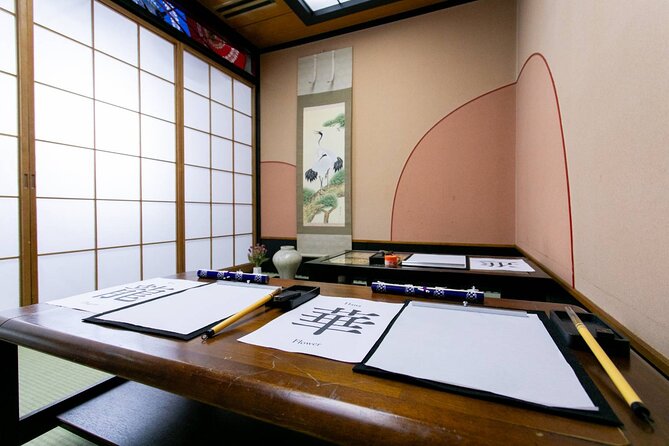
The value here is not just the costume. It’s the way Japanese calligraphy (shodo) is taught as a craft and a mindset. Instead of treating it as decorative writing, you’ll learn how Japanese shodo is practiced, how the tools matter, and how the brush movements connect to concentration.
And yes, the kimono is part of the fun. But what makes it practical is that you get dressed, learn, and make your final draft in about an hour—so it works even if you’re on a tight sightseeing schedule.
Finding the Place, Getting Dressed, and Staying On Time
The meeting point is in Osaka, Joto Ward (Shiginonishi), at an address listed as 2-chōme 3-19, with the name Excellence Takayama. The experience is near public transportation, and one practical tip from what people share is that the location can be easy to miss at first because it’s a small storefront setup.
Here’s how to keep your first five minutes from turning into stress:
- Arrive a little early and use the exact meeting point given on your confirmation.
- Use the restroom before dressing, since changing happens before you start writing.
- Plan to walk in comfortable shoes, then switch into the traditional clothing.
You’ll also be asked to sign a liability waiver before the experience. That’s normal for activities where you’re seated, handling tools, and wearing traditional attire.
One more timing rule that matters: if you’re more than 30 minutes late, entry may be refused. So if you’re trying to fit this after a castle visit, build in a buffer.
The Full 1-Hour Flow: What Happens From Brush to Final Photo
This class runs about one hour and follows a clear progression. Even if you have zero Japanese, the structure helps you keep up and feel productive.
Dressed for old Osaka a while longer
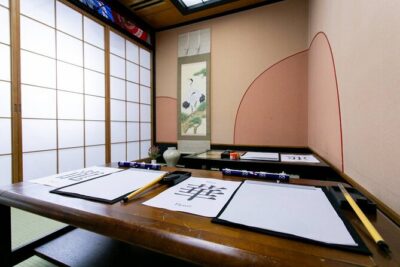


Step 1: Dressing in traditional clothing
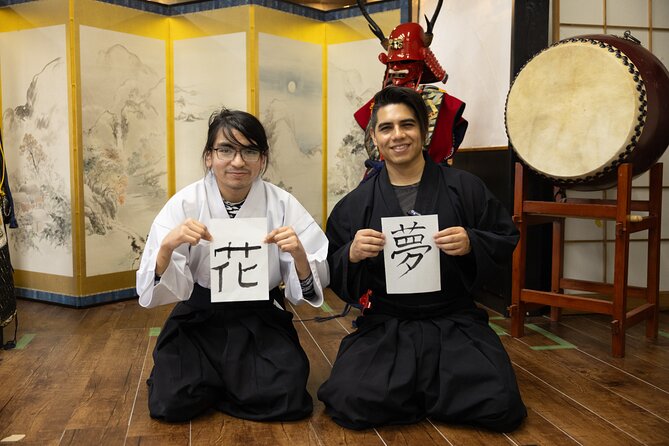
You’ll change into traditional Japanese attire such as a kimono, and sometimes hakama is mentioned as part of the styling. The dressing process can take a bit because it involves several parts. The good news is that you’re not doing it alone.
Practical tip: wear clothes that are easy to slip on and off, and avoid anything tight at the waist. Traditional attire can feel restrictive until you settle in.
Step 2: Mindset and tools (why shodo feels different)
Before you write, you’ll get context on how calligraphy as decorative writing overseas differs from Japanese shodo. You’ll learn what the tools are meant to do and what the teacher expects from your posture and brush control.
This part matters because it stops you from treating the strokes like calligraphy as an art project only. You’re learning craft technique plus a calm focus.
Step 3: Holding the brush and basic movements
You’ll practice how to hold the brush and use the tools. Then you move into the basics of the brush movements:
- tome
- hane
- harai
These are the smallest building blocks, but they’re taught early because they shape how the ink lands and how each stroke ends.
Step 4: Choose your kanji
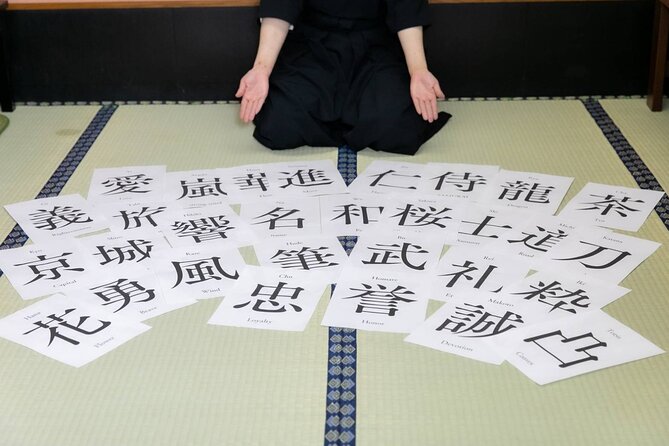
You pick a favorite Japanese kanji to challenge yourself. Kanji can be the most difficult part of learning Japanese, and the characters can carry different meanings depending on the character itself. In class, you’re not memorizing a whole language—you’re picking one kanji and learning how to write it correctly.
You’ll connect that choice to your own name, too. The class includes a moment where the teacher writes the foreign names of participants on wooden tags using the kanji they chose.
Step 5: Stroke order practice
You’ll learn the stroke order for your chosen kanji, then practice. Stroke order is not just tradition here; it’s how you avoid writing the strokes in a way that looks uneven or unstable.
Step 6: Surprise wooden name tags
This is a highlight because it’s personal. The teacher writes participants’ names on wooden tags using the kanji you selected. It turns the class from a one-off activity into something you can keep and show later.
Step 7: Final draft
After practicing, you’ll write a final draft while keeping what you learned in mind. This is the point where everything starts to click. You’ll likely feel slower at first, then more confident as the strokes become familiar.
Step 8: Photo shoot
Then you get a photo moment in your kimono outfit with your artwork. The experience allows smartphone photography for your own shots as long as you follow etiquette: no selfies and no photographing other guests.
Afterward, photography is provided by the hosts as part of the experience, and the digital photos are sent to your designated email address.
Picking Kanji That Actually Gives You a Personal Result
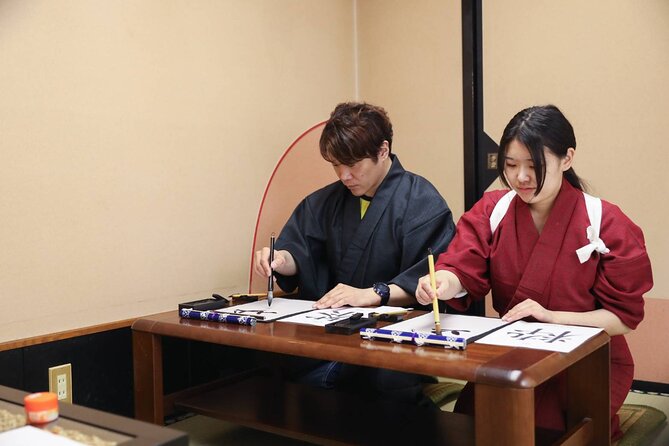
Kanji selection is one of the clever parts of the class because it makes the lesson feel like it’s about you. You don’t get assigned a random character and told to copy it forever. You choose your own kanji to challenge yourself.
And you get two layers of personalization:
- You’ll practice the kanji you chose.
- Your name appears in kanji on a wooden tag as part of the surprise.
That second piece is a big deal for many visitors because it turns learning into a souvenir. It’s not just a photo. It’s your name translated into kanji characters—something you can keep.
If you’re wondering whether you’ll understand what you’re writing, don’t worry about being fluent. The class is designed for all skill levels, and you get language support through translation.
Brush Technique in Plain Terms: Tome, Hane, Harai
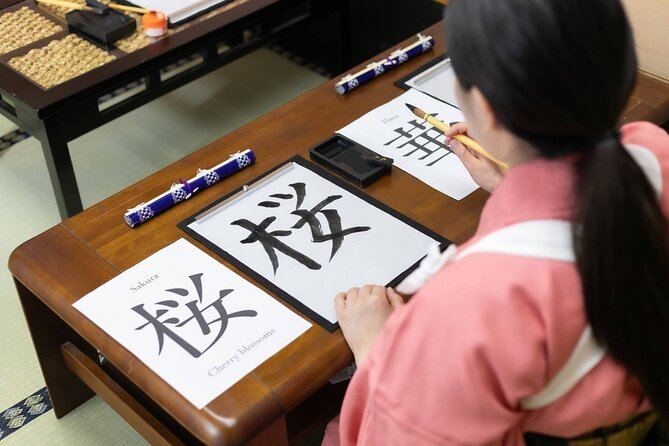
People often think calligraphy means fancy brush flourishes. In this class, the core is simpler and more technical: accurate brush movement.
You’ll start with how to hold the brush, then you’ll learn the basics of how strokes behave:
- tome (a controlled stop)
- hane (a snap or spring in direction)
- harai (a sweeping pull)
Your teacher guides you on brush technique and stroke order, then watches you as you practice. That mix is what makes it work for first-timers. You’re not left guessing, and you’re not rushed into a final piece before you understand the mechanics.
The best way to get value out of the class is to focus on the stroke endings. Tome, in particular, is where beginners usually lose control. If you get the “stop” right, the whole character starts to look more intentional.
Your Take-Home Goods: Tags, Your Writing, and Digital Photos
This experience is built to leave you with multiple keepsakes, not just a memory.
Wooden name tag
The wooden tag written in kanji is a fun, tangible result. It’s also a conversation starter because you can explain that it was made from the kanji you chose during class.
Your written work
You’ll write a final draft, and you should expect to take home your practice work as well. Some participants describe receiving a satchel or gift bag filled with their calligraphy pieces, which fits the class’s souvenir element.
Photo set emailed to you
The photo shoot is included, and the digital photos are sent to your designated email. That matters because you won’t need to rely solely on your phone for the “kimono + artwork” shots.
For the photo moment, I’d treat it like a mini portrait session: stand tall, relax your shoulders, and keep your artwork in frame. The teacher will take photos throughout, so you won’t feel like you’re working while performing.
Optional extra: wagami
An optional wagami (collected hair + kanzashi) is offered as a paid add-on at ¥3,300 per person. If you want the hairstyle to match the kimono styling fully, it’s worth asking about. If you’d rather keep the session simpler, you can skip it and still get fully dressed.
Language Support You Can Rely On (Even If Your Japanese Is Zero)
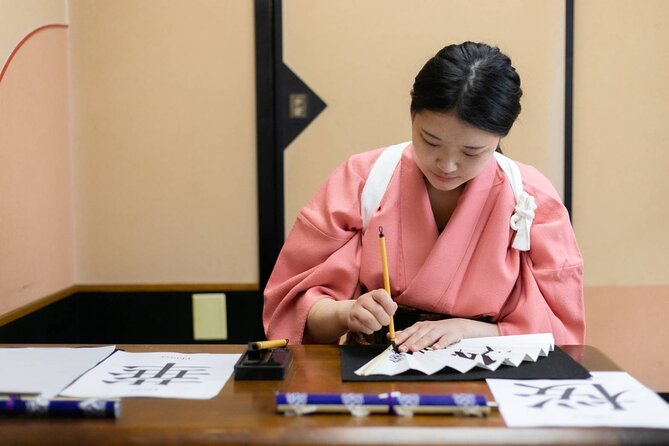
The default language is English. If you need another language, you can inquire about options including Italian, Spanish, French, Chinese, Thai, or Indonesian, but language support isn’t guaranteed due to limited staff availability.
During the class, translation support is available (English-Japanese and Chinese-Japanese help is mentioned), which is exactly what you want for a skill-based activity. It’s one thing to understand directions. It’s another thing to have someone help you understand what a stroke is supposed to do.
In practice, the teacher’s body language and step-by-step guidance do a lot too. Even if your language understanding is basic, the brushwork is visual and you can follow along.
Who This Class Is Best For (And Who Might Skip It)
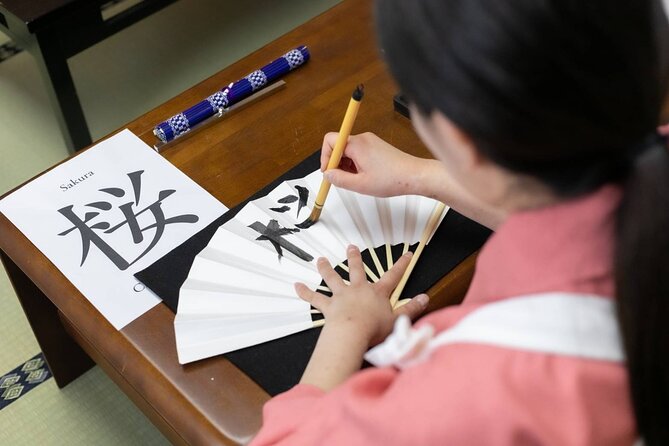
This experience is open to all skill levels, including kids. If you’re traveling with children, this is the kind of activity that can feel focused without being too technical.
It’s also great if you:
- want a calm, hands-on cultural activity near Osaka Castle
- like getting photos in traditional attire
- want a personal kanji result tied to your name
- enjoy learning a craft through repetition
But it may not be the best fit if you:
- have back problems or heart conditions (not recommended)
- need stroller access (not stroller accessible)
- are traveling with pets (not suitable)
Also, remember the etiquette rules: no selfies, and avoid fixed tripods or recording videos so other guests aren’t disturbed.
Price and Value: What You’re Paying For at $43.59
At $43.59 per person for about an hour, the cost makes sense because you’re not only buying an art lesson. You’re buying:
- instruction from a shodo teacher
- traditional attire (kimono, and hakama or similar styling)
- photography support (and digital delivery by email)
- help with language barriers
- a class setup designed for a small group (maximum 10)
You’re also getting structure. Stroke order, tool use, and brush movements are taught in a sequence that turns you from curious to capable in a short window.
Do keep in mind what can change your total:
- optional wagami add-on (¥3,300 per person)
- your own transportation to the meeting point (transfers aren’t included)
Demand seems to be steady—this class is often booked weeks in advance—so if you’re visiting during peak season or a holiday week, reserve early.
Practical Snags to Plan For Around Osaka Castle Park
Two things can trip people up near famous attractions.
First is finding the storefront. One practical lesson from what people share is that the address can lead you to a building area, and you may need extra minutes to spot the small setup. That’s not a reason to skip. It’s just a reason to arrive early with calm energy.
Second is schedule mismatch. If you’re running late from castle sightseeing, build buffer time. The class can refuse entry if you’re more than 30 minutes late, and traditional dressing means you don’t want to rush at the start.
There’s also a rare risk pattern you should know about. The provider has reported temporary closure during June 9–29, 2025 due to an operator issue, with refunds handled afterward. That’s unusual, but it’s smart travel behavior to double-check your confirmation message as your date approaches.
Finally, plan for traditional clothing comfort. You may sweat easily while wearing hakama or armor in general guidance for this provider, so dress in a way that makes the heat and fabric manageable.
Should You Book This Shodo-and-Kimono Class?
If you want one high-impact cultural experience that doesn’t require Japanese fluency, I’d book it. The mix of hands-on calligraphy, kimono dressing, and personal kanji results for your name makes it feel like more than a “take a class” stop.
I’d especially recommend it if you’re already doing Osaka Castle and you want something quieter and more human-scale afterward. One hour is enough to learn the basics, produce a finished draft, and walk away with a meaningful souvenir plus photos.
Skip it if you:
- need stroller-friendly access
- have health concerns that make sitting and traditional attire hard
- expect a long, deep explanation session about kanji meanings and grammar
If you book, do this: bring your curiosity and your patience, pick a kanji that you like the look of, and treat the stroke practice as your main goal. The payoff is your name in kanji, your final draft, and a set of photos that actually show the result.
FAQ
How long is the Japanese calligraphy class?
It lasts about 1 hour.
What language is offered during the class?
English is the default. You can inquire about other languages such as Italian, Spanish, French, Chinese, Thai, and Indonesian, but availability is not guaranteed.
Can kids participate?
Yes. The class is open to all skill levels, and kids can join.
What’s included in the experience?
Included items include the lesson (from introductory up to professional), traditional Japanese attire (kimono, hakama, etc.), photography with digital photos sent to your email, and help from translation support.
Do I get to take photos during the class?
Yes. Smartphone photography is permitted, as long as you do not take selfies or photograph other guests. Fixed tripods and recording videos are not allowed.
Where is the meeting point?
The meeting point is listed at Japan, Osaka, Joto Ward, Shiginonishi, 2-chōme 3-19 (Excellence Takayama). It’s near public transportation and the activity ends back at the meeting point.
What if I’m late?
If you are more than 30 minutes late for your reservation, you may be refused entry.
Is there a refund if I cancel?
You can cancel up to 24 hours in advance for a full refund.
Is wagami included?
No. Wagami (collected hair + kanzashi) is an optional paid upgrade at ¥3,300 per person.
Made in Osaka, by You
- Osaka: Tea Ceremony, Calligraphy, and Kimono Experience★ 4.9 · 130 reviews
- 1.5〜2 Hours Traditional Kintsugi Work Shop in Namba Osaka★ 5.0 · 75 reviews
- Osaka: Private Japanese Calligraphy Experience★ 5.0 · 66 reviews
- From Osaka: Sakai Knife Maker or Blacksmith Walking Tour★ 4.9 · 64 reviews
- Osaka: Traditional Japanese Ceramics Private Experience★ 5.0 · 57 reviews
In Kimono Around Osaka
- Osaka: Sumo Show & Experience w/ Optional Kimono & Hot Pot★ 4.5 · 609 reviews
- Osaka: Tea Ceremony, Calligraphy, and Kimono Experience★ 4.9 · 130 reviews
- Osaka: Kimono or Yukata Rental &Photos Service Options★ 4.9 · 25 reviews
- Kimono photoshoot-Includes 100 photo data★ 5.0 · 21 reviews
- Premium Kimono Dressing, Tea Ceremony, Calligraphy, Samurai show★ 5.0 · 18 reviews
Osaka Castle, Seen Properly
- Osaka Castle: Museum and Tower Entry Ticket★ 4.5 · 2,380 reviews
- Osaka Castle Walking Tour and Castle Tower Admission★ 5.0 · 561 reviews
- 5-Hour Osaka Bike Tour to the Neighborhood of Osaka Castle★ 5.0 · 319 reviews
- Osaka Castle Guided Tour★ 4.7 · 249 reviews
- Osaka: Castle History Walking Tour / Castle Tower Admission★ 4.9 · 230 reviews
The Newest Osaka Write-Ups
- Private Photoshoot in Osaka with a Professional Photographer
★ 5.0 · 3 reviews - Osaka Early Morning Osaka Castle Tour Avoid Crowds
★ 5.0 · 3 reviews - Nara Private Tour with Pick and Drop and English Speaking Driver
★ 3.5 · 3 reviews - Osaka: Modern Vegetarian Sushi Cooking Class
★ 5.0 · 3 reviews - Nara Day Trip from Osaka with a Licensed Guide
★ 5.0 · 3 reviews
Osaka Castle Tours & Tickets, compared.
 ★ 4.5Osaka Castle: Museum and Tower Entry TicketFrom $72,380 reviews
 ★ 5.0Osaka Castle Walking Tour and Castle Tower AdmissionFrom $23561 reviews
 ★ 5.05-Hour Osaka Bike Tour to the Neighborhood of Osaka CastleFrom $87319 reviews
 ★ 4.7Osaka Castle Guided TourFrom $43249 reviews
 ★ 4.9Castle History Walking Tour / Castle Tower AdmissionFrom $33230 reviews
 ★ 4.7Osaka Castle Guided Tour with Local GuideFrom $4878 reviews
 ★ 5.0PRIVATE 6hr, Food tour from Osaka Castle, Kuromon, Dotonbori.From $15568 reviews
 ★ 4.5A Tour to Explore the Symbol of Osaka: Osaka CastleFrom $8356 reviews
Browse the lists this tour appears in